



Every mechanical puzzle makes a promise: you can solve this. The difficulty rating tells you how hard it will make you work first. If you've ever picked up a brain teaser that fell apart in thirty seconds, or one that sat untouched on a shelf for a year, you know why that number matters.
This guide explains how to read puzzle difficulty levels, what changes as you move up the scale, and how to pick the right challenge for yourself or for the person you're shopping for.
How our difficulty scale works
Most Project Genius brain teasers carry a difficulty rating from 1 to 5, printed on the product page next to the recommended age. The rating is a guide to how much time, patience, and lateral thinking a typical solver should expect to put in. It is not a test score. Two people can find the same puzzle very different, depending on whether it plays to their strengths.
In general, the numbers break down like this:
- 1/5 to 2/5, warm-up: The goal is clear and the path is fairly forgiving. A few minutes of fiddling often gets you there. Great for first-time puzzlers and younger solvers in the recommended age range.
- 3/5, a real challenge: You'll need to stop, look closely, and think about how the pieces actually move. Expect some trial and error before the aha.
- 4/5, advanced: Several steps have to happen in the right order, or there are many possible arrangements and only a few that work. Patience becomes part of the puzzle.
- 5/5, expert: Built for people who have solved plenty of puzzles and want something that pushes back. These can take multiple sittings.
What actually makes a puzzle harder
A puzzle doesn't get harder just by adding pieces. Difficulty usually comes from a few specific sources, and knowing them helps you guess which puzzles will suit you.
Hidden mechanisms
Trick locks and secret puzzle boxes hide how they work. The goal ("open it") is obvious, but the method is not. These reward curiosity and careful observation more than raw logic.
Sequence and order
Disentanglement puzzles and sequential-movement puzzles often need a series of moves in a precise order. Miss one step and you're back where you started. The difficulty grows with the number of moves you have to remember.
Spatial reasoning
Assembly puzzles, where you take something apart and rebuild it, ask you to picture how pieces fit in three dimensions. Taking them apart is the easy half. Getting them back together is the puzzle.
Logic and math
Dial and number puzzles have many possible combinations and only one (or a few) correct answers. They favor people who enjoy working methodically and keeping track of what they've already tried.
Where to start: a set that spans every level
If you're not sure where you or your recipient falls on the scale, start with a set that covers the full range.
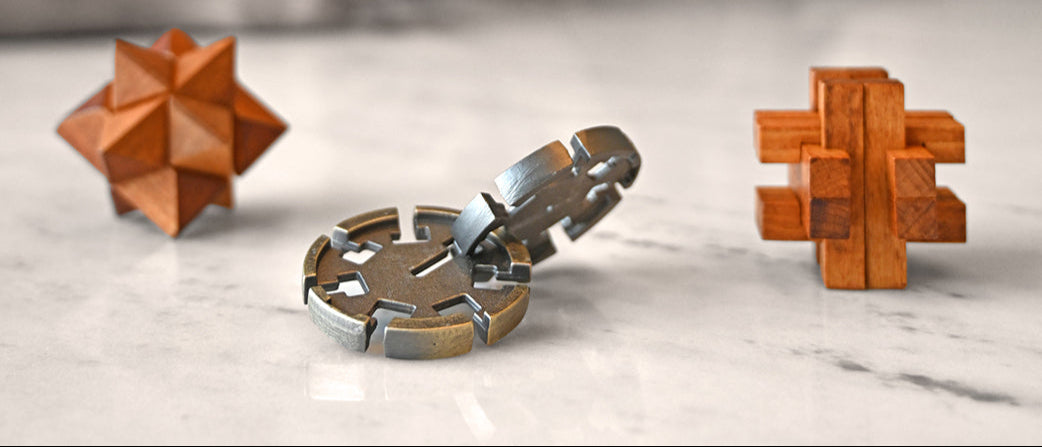
- Ancient Metal Puzzle Set, 12 Pack ($14.99). Twelve metal disentanglement puzzles with difficulty that varies from 1/5 to 5/5. It's the easiest way to find your level: work through the simpler ones, notice where you start to slow down, and you've found your sweet spot. It's also a great pick for families or groups, since everyone can grab one that fits.
Level 3: your first real challenge
A 3/5 puzzle is where most people get properly hooked. It's hard enough to make you stop and think, and satisfying enough to make you want the next one.
- Roman Arches, Interlocking Metal Puzzle ($5.99). Separate two interlocking metal arches, then put them back together. Simple to understand, surprisingly tricky to do, and small enough to keep in a bag or on a desk.
- Grecian Trick Lock ($14.99). A key-and-lock puzzle where the goal is simply to open it with the tools provided. As you'll find out, the obvious approach is not the one that works.
Level 4: advanced solvers
Once 3/5 puzzles start falling quickly, it's time to step up. These ask for more patience and a more deliberate approach.
- Appian Way Roman Cube Puzzle ($5.99). Take apart a cube made of 12 smaller pieces and reassemble it into a seamless whole. A compact spatial-reasoning test that punches well above its size.
- Caesar's Calendar ($15.99). Arrange the pieces on the board so only today's date shows. There's a solution for every day of the year, so it's a new puzzle every morning.
Level 5: for the expert
For the puzzler who says nothing stumps them, this is where to point them.
- Grecian Computer, Mathematical Dial Puzzle ($15.99). Our most challenging puzzle. Turn the dials until all 12 columns add up to 42. It rewards careful, methodical thinking, and it looks great sitting on a desk while you work on it.
How to pick the right level
A few simple rules of thumb:
- Brand new to mechanical puzzles? Start with a mixed set or a 3/5 puzzle. Success early on builds the patience you'll need later.
- Buying a gift and unsure of their level? A multi-level set is the safest choice. If you know they already love puzzles, go one level higher than you think. Solvers usually enjoy being challenged more than being underwhelmed.
- Know what they like? Match the puzzle type as well as the number. A logic lover may breeze through a 5/5 dial puzzle and get stuck on a 3/5 trick lock, and the reverse is just as common.
- Solving with kids? Check the recommended age on the product page, and pick a lower-numbered puzzle you can work on together.
Tips for when you get stuck
Getting stuck is part of the fun, and it's usually a sign you're close. A few habits help at any level:
- Slow down and look. Many puzzles give small clues through shape, gaps, or where a piece seems to want to move.
- Never force it. Mechanical puzzles are designed to come apart without pressure. If you're pushing hard, it's the wrong move.
- Retrace your steps. For sequence puzzles, try to remember the last position where something changed, and start from there.
- Walk away. Plenty of puzzles get solved five minutes after you put them down and come back with fresh eyes.
And if you truly need a hand, our Puzzle Solutions collection has walkthrough videos for our puzzles, so a tough challenge never has to turn into frustration.
Find your level
The best puzzle is one that's just a little harder than you think you can handle. Browse our best sellers for crowd favorites across every level, or explore the full True Genius collection of wood and metal brain teasers, and check the difficulty rating on each product page to find your next challenge.