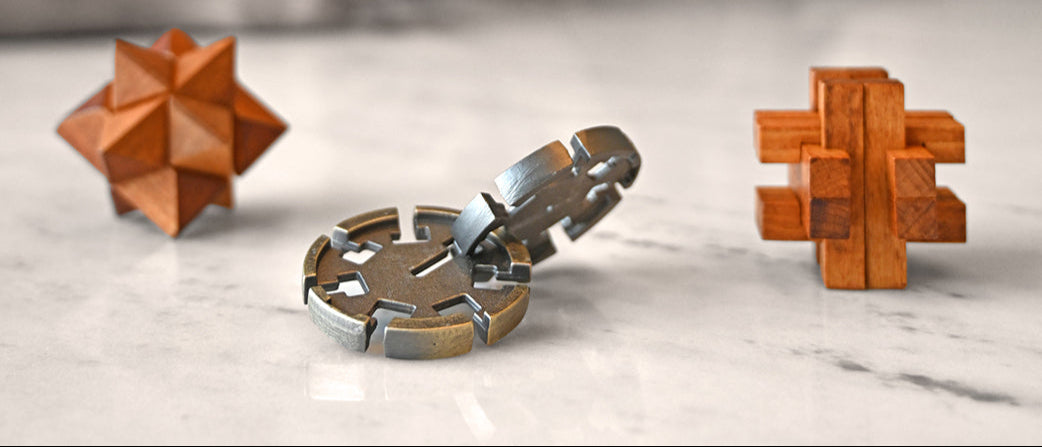




There's a particular kind of frustration that comes with a metal disentanglement puzzle. You turn it over in your hands, two pieces of interlocked metal that clearly want to come apart, and yet they refuse. Then, sometimes minutes later and sometimes days, something shifts. A piece slides through a gap you swear wasn't there before, and the two halves fall open. That quiet click of understanding is the whole reason people love these puzzles.
If you're new to them, though, the early going can feel like guesswork. It isn't. Metal disentanglement puzzles follow a small set of principles, and once you know what to look for, you'll solve them faster and enjoy the process a lot more. Here's how to get started.
What is a disentanglement puzzle?
A disentanglement puzzle, sometimes called a tanglement or take-apart puzzle, is made of two or more pieces that are linked together. Your job is to separate them, and then, ideally, put them back the way you found them. The classic versions are formed from bent metal wire, rings, and shaped loops, though you'll also see nails, horseshoes, and cast pieces that interlock in clever ways.
The key thing to understand is that these are not strength puzzles. If you find yourself pulling hard or reaching for pliers, stop. A well-made disentanglement puzzle comes apart with almost no force at all. The challenge is finding the path, not muscling the pieces through it.
Start by understanding the puzzle, not solving it
Before you try to take anything apart, spend a minute just looking. Turn the puzzle slowly and trace how the pieces are connected. Ask yourself a few questions: Where do the two pieces actually touch? Is there a loop, a gap, or an opening that one piece might be able to pass through? Which part seems fixed, and which part has room to move?
Most disentanglement puzzles have one piece that is relatively rigid and another that has an opening or a shape designed to travel along it. Identifying that traveling piece and the gap it's meant to slip through is usually most of the battle.
The core techniques
Look for the gap
Nearly every metal ring or wire puzzle is solved by moving a loop or ring through a specific opening. That opening is often small and easy to overlook. Follow each piece with your eyes and find the narrowest point where one part could pass through another. That gap is your route.
Follow the shape
The bends and curves in a wire puzzle aren't decorative. Each turn is there to guide a piece along a hidden path. Instead of yanking, let the movable piece follow the contour of the metal. If it stops, you've likely reached a point where it needs to rotate or change direction rather than continue.
Rotate and reorient
When a piece won't go any further, the answer is almost always rotation. Twist the loop ninety degrees, flip the whole puzzle over, or turn a ring so it lines up flat with the gap it needs to cross. Disentanglement puzzles reward small, deliberate turns far more than big pulling motions.
Work in both directions
If you make progress and then get stuck, back up. Reverse the last move or two and try a slightly different angle. Solving these puzzles is rarely a straight line; you'll often advance, retreat, and advance again along a slightly better path.
Remember how it came apart
The moment a puzzle opens is exciting, but pause before you celebrate. Take note of the sequence, because putting the puzzle back together is its own challenge, and it's a lot easier if you can retrace your steps rather than starting from scratch.
Common beginner mistakes
The biggest one is force. These puzzles are engineered to separate cleanly, so bending or pulling hard will only distort the metal and make the solution harder to find. The second mistake is moving too fast. Rapid trial-and-error feels productive but tends to blur the small, meaningful movements together. Slow down, make one change at a time, and watch what happens. Finally, don't give up the first time you're stuck. Being stuck is part of the design. Set the puzzle down, come back with fresh eyes, and you'll often spot the path within seconds.
Which metal puzzles should a beginner start with?
The best way to learn is with genuine puzzles that vary in difficulty, so you can build confidence before tackling the harder ones. A few well-loved starting points from the True Genius collection:
The Yin Yang Metal Ring Puzzle ($5.99) is a classic two-coil disentanglement challenge rated 3 out of 5, which makes it an ideal first puzzle. Separating and reconnecting the interlocked coils teaches the fundamental "find the gap and follow the shape" technique better than almost anything else.
The Roman Arches Interlocking Metal Puzzle ($5.99) and the Silk Worm Metal Ring Brainteaser ($5.99) are both in the same friendly 3-out-of-5 range. They introduce slightly different shapes and paths, so working through all three is a great way to practice reorienting pieces rather than pulling them.
Once those feel comfortable, the Viking Sun Compass ($9.99, difficulty 4/5) steps things up with a more involved path, and the Bolts of Pompeii Interlocking Metal Burr Puzzle ($29.99, difficulty 4/5) moves you into burr-style puzzles, where several pieces come apart in a specific order.
If you'd rather have a whole progression in one box, the Ancient Metal Puzzle Set (12 Pack) ($14.99) is our top pick for beginners. It includes twelve metal puzzles ranging from 1 out of 5 all the way to 5 out of 5, so you can start easy and work your way up at your own pace without buying a dozen puzzles separately.
When you're truly stuck
Every solver hits a wall now and then, and there's no shame in getting a nudge. Many of our metal puzzles have step-by-step video walkthroughs, and you can find written and video solutions in our Puzzle Solutions collection. Peeking at a solution once, when you're genuinely stumped, won't spoil the hobby. It teaches you a technique you can carry into the next puzzle. Over time you'll need the solutions less and less, until reaching for one feels like cheating rather than help.
The real payoff
Metal disentanglement puzzles are inexpensive, endlessly re-solvable, and genuinely absorbing in a way that a screen rarely manages. They're small enough to keep on a desk or in a bag, and satisfying enough that you'll hand them to friends just to watch them puzzle it out. Start with an easy ring puzzle, take your time, resist the urge to force anything, and enjoy that click of understanding when it finally comes.
Stuck on yours? Find the walkthrough in our Puzzle Solutions collection, or pick up the Ancient Metal Puzzle Set and start building your skills one puzzle at a time.