



Ask ten puzzle people whether they prefer wood or metal and you will get ten different answers, usually delivered with some heat. It is not a trivial distinction. The material a brain teaser is made from shapes how it is solved, how it feels in your hands, how long it holds your attention, and whether it ends up on a shelf or in a pocket.
If you are buying your first mechanical puzzle, or your first one as a gift, here is an honest comparison of the two families and how to figure out which one fits.
The short version
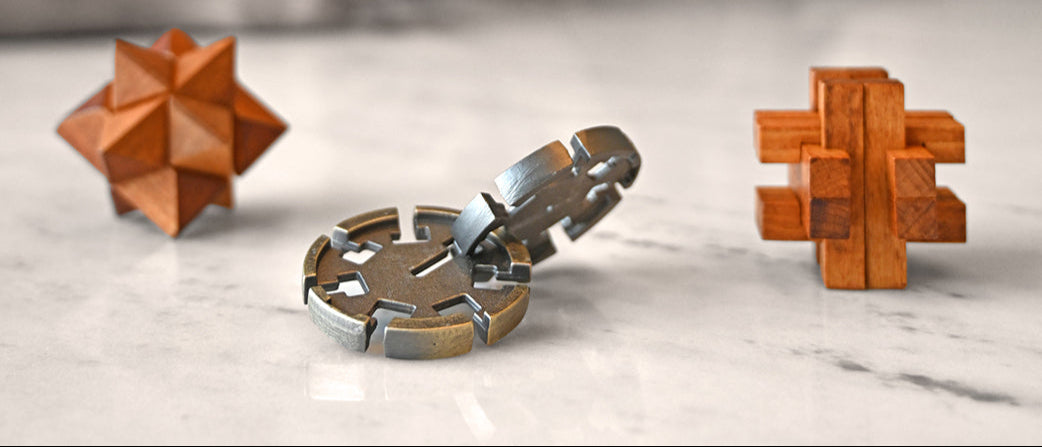
Metal puzzles are mostly about untangling. Two or more pieces are linked, and your job is to find the one path that separates them. They are small, durable, cheap enough to buy several at once, and they travel well.
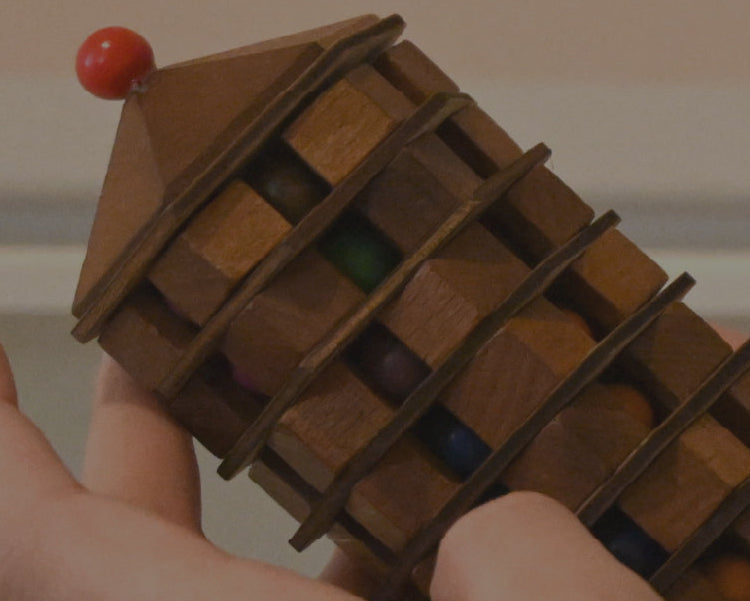
Wooden puzzles are mostly about assembly, sequence, and logic. You are taking something apart and putting it back together, or arranging pieces so a condition is satisfied. They tend to be larger, handsome enough to leave out on a coffee table, and they reward patience over dexterity.
Neither is harder as a category. The hardest puzzles in the world exist in both materials. What differs is the kind of thinking each one asks for.
What metal brain teasers are really like
A metal disentanglement puzzle is a small, self-contained problem. You get a shape in your hands, you can see every part of it at once, and there is no hidden mechanism. Everything you need to solve it is visible. That transparency is exactly what makes them maddening: the answer is right there, and you still cannot find it.
Solving one is a mix of spatial reasoning and something closer to feel. You learn to notice where a loop is slightly wider than the wire it has to pass over, and to test movements rather than force them. Most solutions are shorter than people expect, four or five moves, and the difficulty is in seeing the first one.
They are also the best value in puzzling. The Silk Worm is a good entry point at $5.99, a two-piece ring puzzle that teaches the basic vocabulary of loop-over-loop movement. Once that clicks, the Ancient Metal Puzzle Set gives you twelve different challenges for $14.99, which is the cheapest way we know to find out whether you actually like this kind of thing. A set also makes a better gift than a single puzzle, because nobody solves twelve on the first evening.
For someone who has already worked through the basics, Bolts of Pompeii at $29.99 moves into interlocking burr territory. It is metal, but it behaves more like a wooden puzzle: pieces come apart in a specific order and go back together in the reverse of it. Reassembly is the real challenge.
Metal is the right pick when
- You want something to keep on a desk and fidget with between tasks.
- You are buying for a traveler, a commuter, or anyone who likes a pocket-sized challenge.
- You want multiple puzzles rather than one, whether for a gift basket or to spread across a table at a party.
- You enjoy the hands-on, trial-and-feel side of problem solving more than deliberate planning.
What wooden brain teasers are really like
Wood changes the experience in two ways. First, it allows larger and more complex constructions, which means designers can build in sequence, rotation, sliding mechanisms, and multi-stage logic. Second, it feels different. A wooden puzzle has weight and warmth, and pieces move with a bit of friction that makes the whole thing feel deliberate.
The trade-off is that wooden puzzles usually ask you to think before you move. The Grecian Computer at $15.99 is a clear example: four rotating dials with numbers on them, and one alignment out of thousands that satisfies the condition. There is no feeling your way through it. You have to reason about what has to be true, then test.
Caesar's Codex at $16.99 goes the other direction, into sequential movement. Levers slide and release one another in a fixed order, and solving it is a matter of discovering that order and then remembering it. Puzzles like this tend to produce the most satisfying single moment in the hobby, the one where a mechanism you did not know existed suddenly gives way.
Wood is the right pick when
- You want a puzzle that looks good sitting out, as an object as much as a challenge.
- The solver enjoys planning, patterns, and logic more than manual dexterity.
- You want something a couple of people can lean over together, which is hard with a two-inch metal puzzle.
- You are shopping for someone with an engineering or woodworking streak who will appreciate how it is made.
The honest answer: most people end up with both
We sell plenty of each, and the pattern we see is that people do not stay loyal to one material for long. They start with whichever one caught their eye, solve it, and then want the other kind of challenge. Metal teaches you to see possible movements. Wood teaches you to think several steps ahead. Those are different skills, and each one makes the other easier.
If you would rather not choose, a mixed set settles it. The Museum Collection at $34.99 includes thirty wooden and metal puzzles in one box, which works out to a little over a dollar each and gives you a fair sample of both traditions. It is also the set we most often hear about being passed around a family over a holiday week.
You can browse the full range in the True Genius wooden and metal collection, or start with the bestsellers if you would rather see what other people have had the most fun with.
One last thing, whichever you choose
Buy the puzzle expecting to get stuck. That is the product, not a defect in it. Set it down, come back the next day, and let your brain work on it in the background. The break is usually what solves it.
And if a puzzle genuinely will not budge, you are not on your own. Our Solutions Collection has step-by-step walkthroughs and videos for the puzzles in our range, so a stubborn one can go back on the shelf solved rather than in a drawer forgotten.